
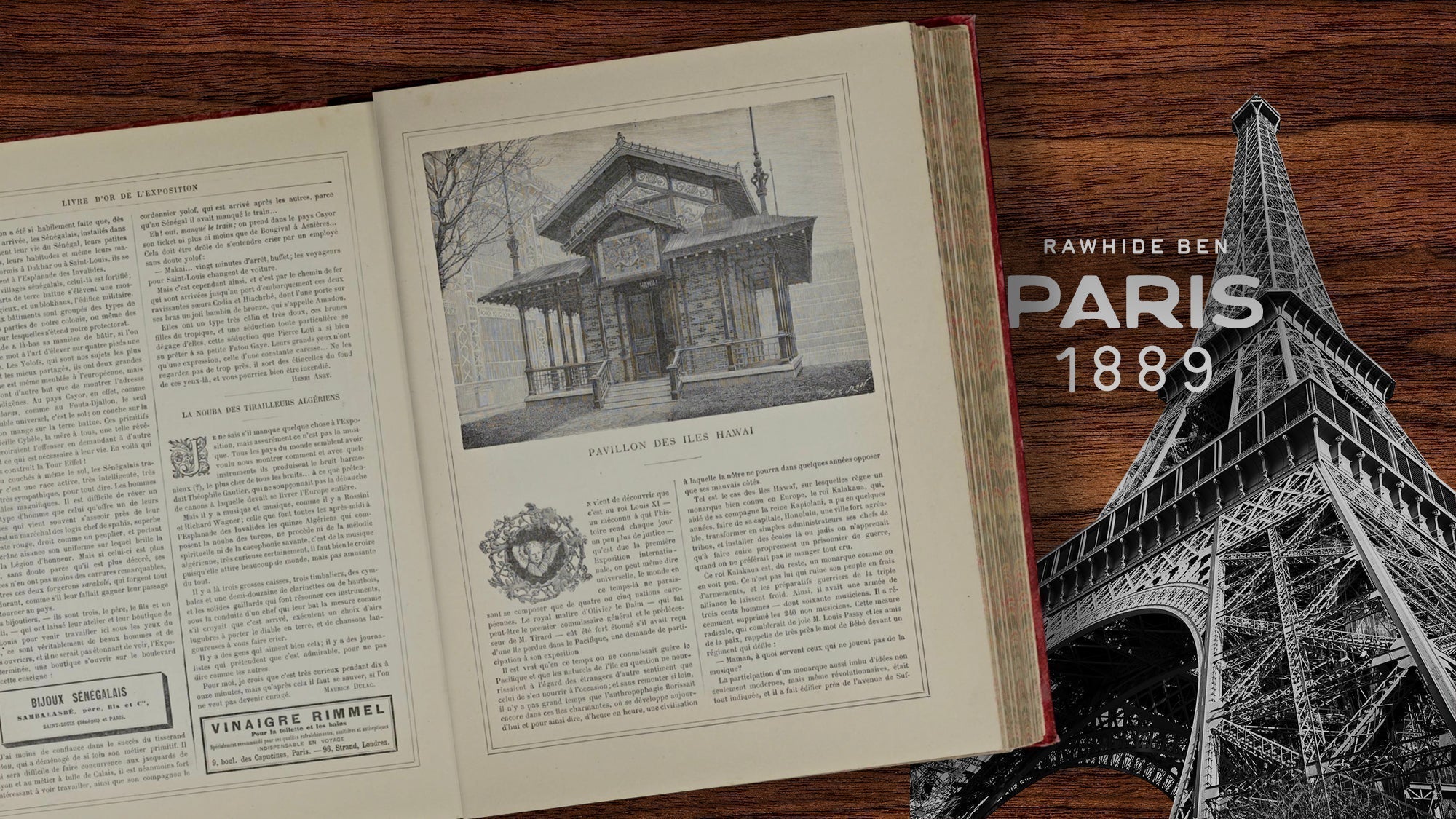
‘Rawhide Ben’ and The Saga of the Paris Exposition
Author: Perry Arrasmith
In 1889, an illegally distilled liquor traveled from an underground distillery in Hawaiʻi Island's Waimanu Valley to the halls of the Exposition Universelle (World’s Fair) in Paris. The Eiffel Tower had been built for the occasion, which brought thousands of people and dozens of governments together from around the world. Among the governments represented at the event was the Kingdom of Hawai‘i.

To some embarrassment, the event also brought international attention to the high quality of its ‘ōkolehao. The irony, here, is that the drink was widely regarded as illegal.
The bottle’s journey to Paris started with Eben "Rawhide Ben" Low, a paniolo (Hawaiian Cowboy) whose nickname followed him for the rest of his life. Col. Sam Parker, a leading Hawaiian politician and heir to the Parker Ranch, had given Low two gallons of ‘ōkolehao distilled in Waimanu Valley.
“In the old days the Hawaiians of Waimanu were noted for the excellence of the liquor they made,” Low recalled in 1925. “Copper stills were used and the liquor was given three different distillations.” Low wanted to send the ‘ōkolehao to Paris, but he had a problem.
Under the laws of the Hawaiian Kingdom, possessing ‘ōkolehao was a serious crime. Before sending a sample abroad, Low sought cover from John E. Hassinger, the then-chief clerk of the Kingdom's Department of the Interior. Lorrin A. Thurston, the figure who eventually orchestrated the overthrow of the Hawaiian Kingdom in 1893, was the interior minister at the time. Hassinger agreed to grant immunity in exchange for a bottle of his own.
Hassinger’s decision is a reminder that while the laws of the Kingdom frowned on ‘ōkolehao, the officials charged with upholding those laws still enjoyed a glass (or a bottle). Low had a gallon bottled at Macfarlane & Co., then Honolulu's leading wholesale liquor dealer.
He designed an “attractive label” and wrote descriptions in Hawaiian and English; the late Pierre Jones translated them into French. Of the four bottles produced, one went to Hassinger, one to Sanford B. Dole (the future President of the Republic of Hawai‘i and first Territorial Governor), one Low kept for himself, and the last sailed to Paris with the rest of the Hawaiian Kingdom's exhibit.

Colonel Zephanianh Spalding, the Hawaiian commissioner at the exposition, later told Low that the okolehao bottle was the “most outstanding and prominent feature” of the entire exhibit. The French really like the ‘ōkolehao. “Then and there they decided oke was the drink of the immortals. They sent a bronze medal to Hawaii.”
Months later, an official diploma addressed to "the government of Hawaii" arrived in Honolulu, written in French, with Low's name bracketed at the bottom. Low held onto his own bottle, diploma, and medal for the rest of his life, telling one reporter that he was considering locking them in a safe deposit box.
By 1938, Low still had one bottle left. Federal authorities formally declared his aging bottle legal, even though it had been distilled illegally and untaxed. Today, the bottle, diploma, and medal are considered lost.

"Rawhide Ben" earned his nickname through a lifetime of ranch work across Hawaiʻi Island, but it was this quieter act of smuggling that tied him permanently to ‘ōkolehao's history. As the Hawaiian Star put it in 1920, whatever else was peddled around the territory under the same name, "the best okolehao... is made from the ti root, and it was for a bottle of this that Eben Low received a medal from the Paris exposition.”
By 1925, prohibition and other factors had destroyed the indigenous ‘ōkolehao production practices of Waimanu Valley. “This was real ‘ōkolehao,” Low declared, “not the ‘rotgut’ which is being peddled about the country today ruining those who drink it.”
More than a century later, as Ola Brew works to revive authentic, ti-root ʻōkolehao on Hawaiʻi Island, Low's Paris bottle stands as an early reminder of the drinks central, if not controversial, place in Hawai‘i’s history. Even while criminalized at home, ʻōkolehao's quality was recognized on the world stage.
Sources
Photo Source. https://archive.org/details/gri_33125012867228/page/278/mode/2up
Sam Parket Ref. Hawaiian Gazette, Dec. 6, 1907
Hassinger Ref. Honolulu Star-Bulletin, Oct. 10, 1925
https://www.newspapers.com/article/honolulu-star-bulletin-oke-50-years-old/202333094/
https://www.newspapers.com/article/honolulu-star-bulletin-eben-treasures-an/202333218/
%20i...)