Introduction of ʻŌkolehao Distillation in Hawai‘i
Author: Perry Arrasmith
“He was the first who introduced into the island the mode of distilling a spirit from the tee-root, of which, however, he became so fond that the king was obliged to deprive him of his still. When I knew him, he had bound himself by an oath, not to taste spirits except at the new year, at which time he indulged to the greatest excess. He chiefly employed himself in his garden, and had a large stock of European vegetables.”
A Voyage Around the World, P. 104 (1822)

Before 1778, kānaka maoli in the Hawaiian Islands were already extracting alcohol from the kī plant. The starchy root could be beaten down and baked until suitable to be converted into a fermentable sugar. It was thereafter soaked in water and left to sit for a period of time, until to turned into a mildly intoxicating beer.
Western explorers and sailors quickly took note of the methods used to ferment ti root. Peter Corney, an English sea captain who witnessed the process firsthand in 1818, described Hawaiians pounding baked ti root with stone poi pounders and mixing it in barrels or old canoe hulls “till the mass was in a state of fermentation." He was not the only sailor to take note of this method; it was only a matter of time before distillation came into the picture.

In order to turn the mildly intoxicating beverage into a hard liquor with a higher alcohol content, there came the process of distillation. The originator of this method is not fully confirmable, as it is quite possible that several sailors and explorers gradually introduced the technology to the Hawaiian Islands at some point in the early 1800s, if not sooner.
William “Long Willie” Stevenson (also recorded as "Stephenson") is rumored to have reached Honolulu from Australia during the reign of Kamehameha I, in the late 1700s or very early 1800s. Stevenson was not an expert on ti root itself. Instead, Stevenson's contribution to ‘okolehao’s formation was mechanical rather than agricultural. It is rumored, per one early account published in 1822.
***
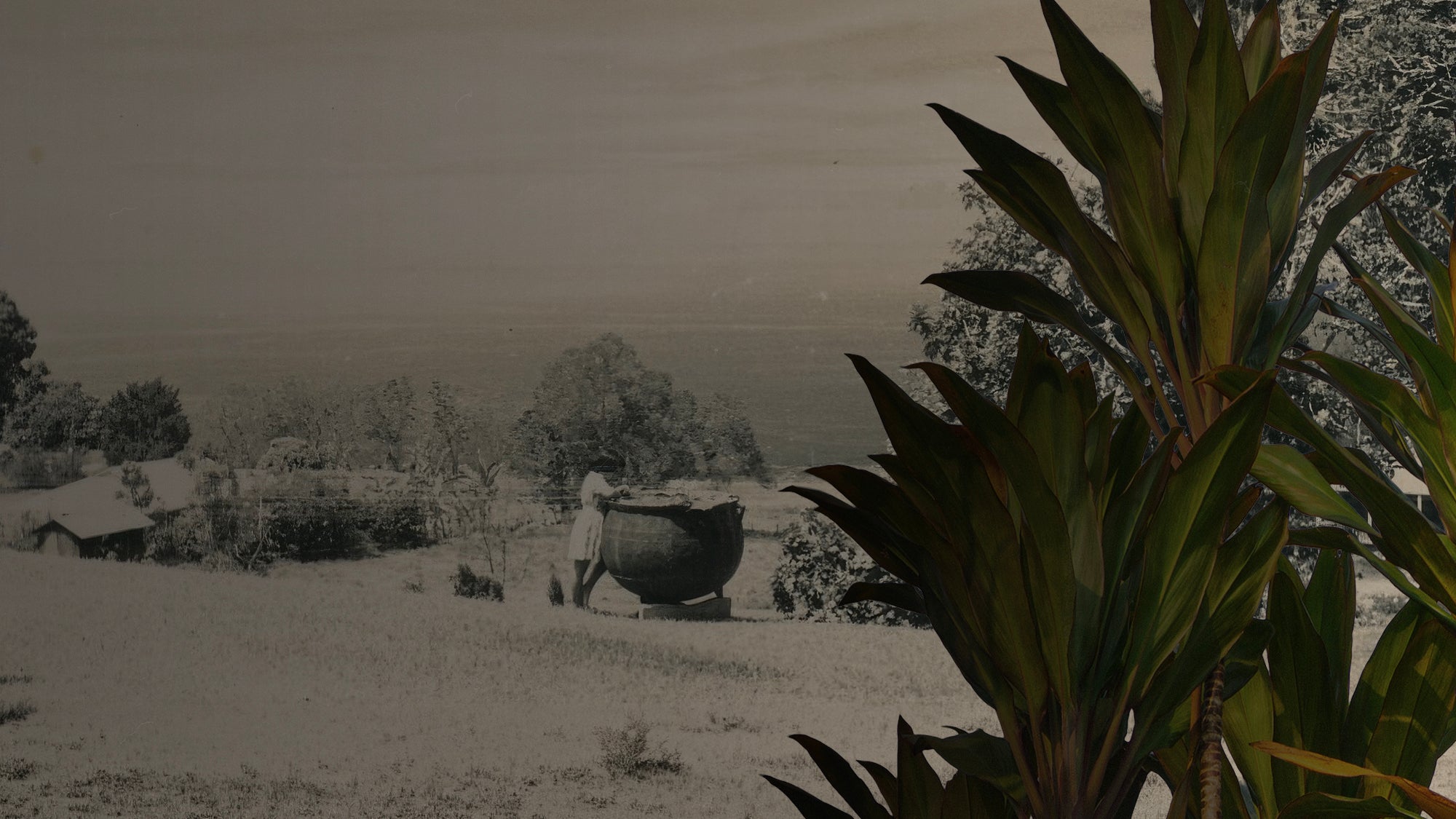
“Their stills are formed out of iron pots, which they procure from American ships, and which they enlarge to any size, by fixing several tier of calabashes above them, with their bottoms sawed off, and the joints well luted. From the uppermost, a wooden tube connects widi a copper cone, round the inside of which is a ring with a pipe to carry off the spirit. The cone is fixed into a hole in the bottom of a tub filled with water, which serves as a condenser.”
***
Through the process of distillation, the mild ti beer Hawaiians already knew became something considerably stronger and quickly grew popular as the technology of distillation spread across the islands. Such popularity became a point of controversy in the Hawaiian Kingdom, kicking off a century-long cycle of prohibition and revival.

Modern spirits historians have largely converged on the same account, if not always the same nickname. The Oxford Companion to Spirits & Cocktails and other researchers describe an ‘escaped Australian convict’ rigging a still from two discarded whaling-ship blubber-boiling pots fitted with a gun barrel, teaching the technique to Hawaiians, who refined and improved it in the decades that followed, including with copper stills by the mid-1800s.
In popular memory, the story survives today largely thanks to a 1968 tribute delivered on the floor of the U.S. House of Representatives. On March 12, 1968, U.S. Representative Spark M. Matsunaga of Hawaiʻi rose on the House floor to honor okolehao as the islands' historic “drink of kings,” entering a Honolulu Advertiser article into the Congressional Record.
In quoting Morley, U.S. Rep. Matsunaga hailed ‘ōkolehao as one of “the Pacific's great gifts.”
The Advertiser article he submitted, “Okolehao: Out of Limbo and Back Into Limelight,” credits “early writers on the islands” with tracing the spirit to “Long Willie Stephenson” and noted that ‘ōkolehao was, by 1968, being revived commercially by Richard K. Kimball of Ti Root Okolehao Hawaii, Inc. Kimball’s efforts arrived as proof that Hawaiʻi has been here before. Nevertheless, Kimball’s ‘ōkolehao was not of the same quality as the type that had been distilled in the islands during the Kingdom period (it was often mixed with cheaper alcohol like Rum).
Regardless of his given name, Stevenson's arrival marks the moment ʻōkolehao became a true distilled spirit rather than a fermented curiosity. For better and for worse, it became an integral part of Hawaiian culture. It is from this long and complicated history of two centuries that Ola Brew now labors to recover a rich legacy.
Sources:
A Voyage Around the World, P. 104 (1822)
https://dn790000.ca.archive.org/0/items/voyagearoundworl00camp/voyagearoundworl00camp_bw.pdf
P. 134, Voyages Around the World (1822).
1818 -- Corney's Northern Pacific Voyages
Oxford Companion to Spirits & Cocktails, "okolehao," https://www.spiritsanddistilling.com/dictionary/acref-9780199311132-e-1145
Congressional Record, remarks of Hon. Spark M. Matsunaga, March 12, 1968, reprinting "Okolehao: Out of Limbo and Back Into Limelight," Honolulu Advertiser, Feb. 20, 1968. 1968 -- Congressional Resolution Recognizing Okolehao